Ontario Development Charges Cut 50%: What It Means for Builders, Housing & Costs in the GTA
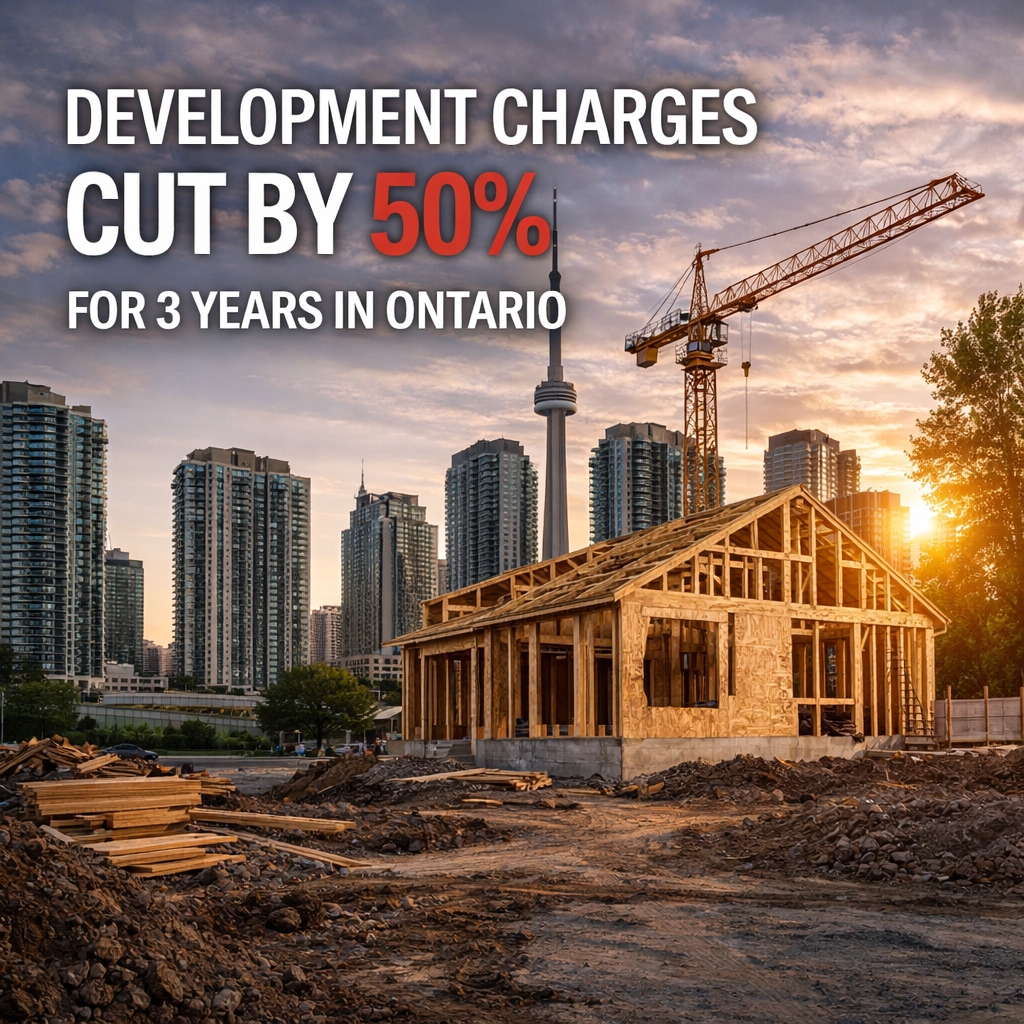
In a landmark announcement, the Government of Canada and the Province of Ontario have introduced a joint housing initiative that will reduce municipal development charges (DCs) by 50% for a three-year period, supported by approximately $8.8 billion in public funding.
This policy is one of the most significant cost-reduction measures introduced in Ontario’s housing sector in decades. For builders, landowners, and investors across the Greater Toronto Area (GTA) and beyond, it represents a rare window of opportunity to accelerate projects, unlock stalled developments, and reshape project feasibility.
But to fully understand its impact, it’s important to go deeper than the headline.
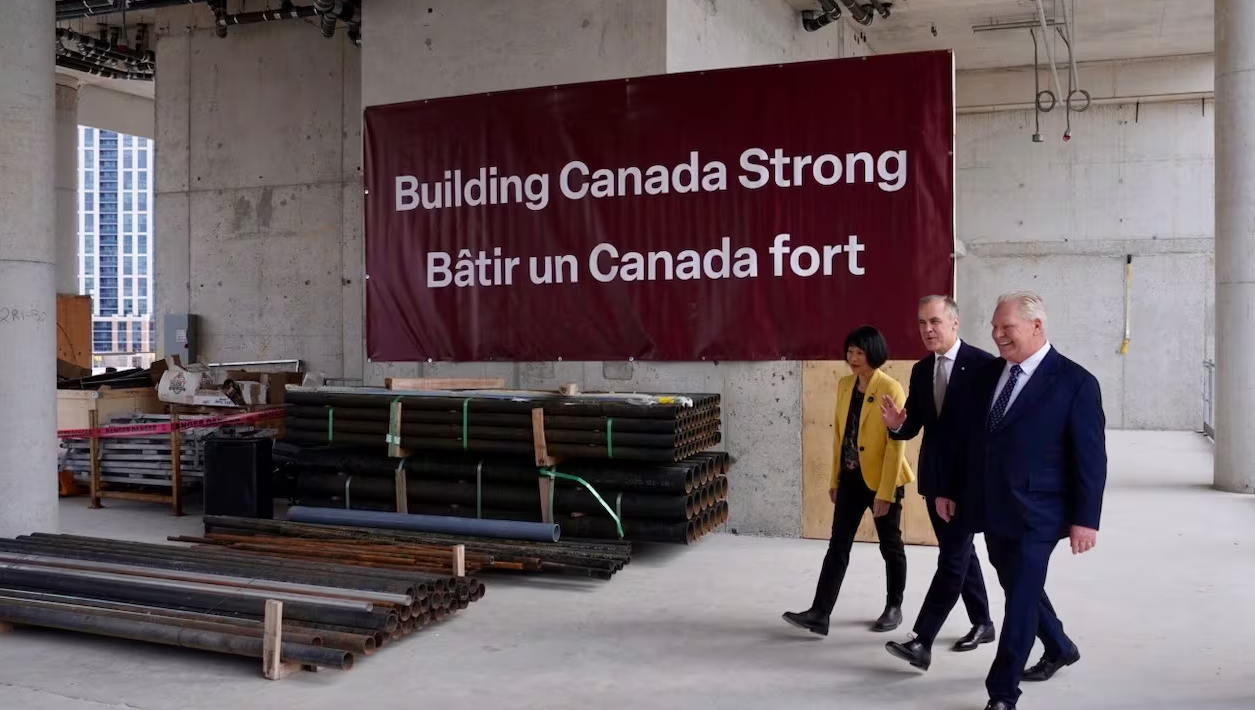
Prime Minister Mark Carney, centre, Ontario Premier Doug Ford, right, and Toronto Mayor Olivia Chow arrive for a news conference in Toronto on March 30, 2026.
Source: Evan Mitsui (CBC)
What Are Development Charges—and What Do They Actually Fund?
Development charges are fees imposed by municipalities on new construction to pay for the infrastructure required to support growth.
When a new home, subdivision, or building is constructed, it creates additional demand on public systems. Development charges are intended to ensure that growth pays for growth, rather than placing that burden on existing taxpayers.
In Ontario, development charges typically fund:
Transportation Infrastructure
Roads, intersections, traffic signals, transit expansions, and road widenings required to accommodate increased population and traffic volumes.Water & Wastewater Systems
Expansion of watermains, pumping stations, stormwater systems, and wastewater treatment capacity.Parks & Recreation
Parkland development, sports fields, trails, and community recreation facilities.Emergency Services
Fire stations, paramedic services, and related capital infrastructure.Libraries and Community Facilities
Public libraries, community centres, and civic buildings tied to population growth.Growth-Related Capital Projects
Broad municipal infrastructure required to service new communities and intensification.
In high-growth municipalities across the GTA, these charges have steadily increased over the past decade and now represent one of the largest upfront costs in residential development, often ranging between:
$80,000 to $150,000+ per low-rise residential unit
Significant additional costs for mid-rise and high-rise developments when combined with other municipal fees and contributions
What the New Policy Changes
Under this new federal-provincial agreement:
Development charges will be cut by 50% for a defined three-year period
Governments will compensate municipalities to offset lost revenue
The objective is to stimulate housing supply quickly, particularly in high-demand regions like the GTA
The program aligns with broader national and provincial housing targets
This effectively removes one of the most significant financial barriers to new construction—without immediately reducing municipal infrastructure funding.

Why This Is a Major Shift in Ontario’s Housing Model
Traditionally, Ontario’s growth model has relied heavily on front-loaded costs paid by developers at the time of building permit issuance.
This announcement represents a temporary shift toward a publicly supported growth model, where:
Governments absorb a portion of infrastructure costs upfront
Builders face reduced capital barriers
Housing supply is expected to accelerate in response
It is both a financial and policy shift—designed to address housing shortages with immediate impact.
How This Impacts Developers—Large and Small
1. Large-Scale Developers
For major builders and institutional developers:
Multi-phase subdivisions and high-density projects become significantly more viable
Reduced DCs can translate into millions in savings per project
Capital can be reallocated toward land acquisition, construction acceleration, or additional phases
Project timelines may compress as more developments move forward simultaneously
2. Small and Mid-Size Builders
This is where the policy becomes particularly impactful.
Smaller builders often face:
Tighter financing conditions
Higher sensitivity to upfront costs
Limited ability to absorb large municipal fees early in the process
A 50% reduction in development charges:
Lowers the barrier to entry for new projects
Improves access to financing and lender confidence
Makes smaller infill, custom home, and low-rise developments more feasible
Allows builders to take on projects that were previously marginal or financially unworkable
In many cases, this policy directly enables smaller operators to compete more effectively in the market.
Real Financial Impact on Projects
To put this into perspective:
A project with $100,000 in DCs per unit now sees that reduced to $50,000
A 10-unit development could save $500,000
A 50-unit project could save $2.5 million
Large-scale communities could see tens of millions in reduced upfront costs
These savings influence:
Project viability
Return on investment (ROI)
Pricing strategy
Speed of project execution
For projects that were previously delayed due to cost pressures, this could be the catalyst needed to move forward.
Will Homebuyers See Lower Prices?
The relationship between development charges and home prices is complex.
While a reduction in DCs does not guarantee a direct, dollar-for-dollar drop in home prices, it does:
Improve overall housing supply
Reduce upward pressure on pricing
Increase the number of projects entering the market
Enhance competition among builders
Over time, increased supply is one of the most effective ways to stabilize housing affordability.
A Time-Limited Opportunity: The 3-Year Window
One of the most critical aspects of this policy is its temporary nature.
The 50% reduction applies for three years, which creates a clear timeline for action:
Developers are incentivized to advance approvals and secure permits quickly
Municipalities may experience increased application volumes
Construction demand may rise significantly, impacting labor and material availability
This introduces a strategic reality:
Timing will be a defining factor in who benefits most from this policy.
Municipal Considerations & Long-Term Outlook
While municipalities are being compensated during this period, key long-term questions remain:
What happens when the program ends?
Will development charges return to previous levels—or increase further?
Will alternative funding mechanisms (e.g., taxation or user fees) be introduced?
Can infrastructure delivery keep pace with accelerated development activity?
The success of this initiative will depend not only on reducing costs—but also on maintaining infrastructure capacity and service levels.
What This Means for the Ontario Housing Market
This announcement signals a clear shift in policy direction:
Governments are prioritizing rapid housing delivery
Cost barriers are being reduced at a systemic level
The development industry is being incentivized to act quickly
For the GTA and Ontario as a whole, this could result in:
Increased housing starts
Acceleration of delayed or stalled projects
Greater participation from small and mid-size builders
A more active and competitive development landscape
The 50% reduction in development charges is more than a temporary incentive—it is a strategic intervention aimed at reshaping housing supply across Ontario.
For developers, investors, and landowners, the next three years present a unique opportunity to capitalize on reduced costs and improved project feasibility.
Those who move early, secure approvals, and act decisively will be best positioned to benefit from this shift.
Broadway Land Planners Ltd. continues to work with clients across Ontario to navigate planning approvals, optimize development potential, and respond strategically to evolving policy changes in the housing sector. Navigating policy changes like Ontario’s 50% development charge reduction requires more than awareness — it requires strategy, timing, and execution. At Broadway Land Planners Ltd., we work with developers, investors, and property owners across Ontario to assess project feasibility, advance planning approvals, and position developments to take full advantage of evolving government policies. Whether it’s a custom home, infill project, or large-scale subdivision, our team provides end-to-end support—from initial concept and land use planning to coordination with architects, engineers, and municipal approvals. In a time-sensitive environment like this, aligning your project with the right approvals and timelines can make a significant difference in overall project success.
To learn how your project can benefit from Ontario’s development charge reductions, contact Broadway Land Planners Ltd. by email at info@blpltd.caor call 647-460-8478 to discuss your project.